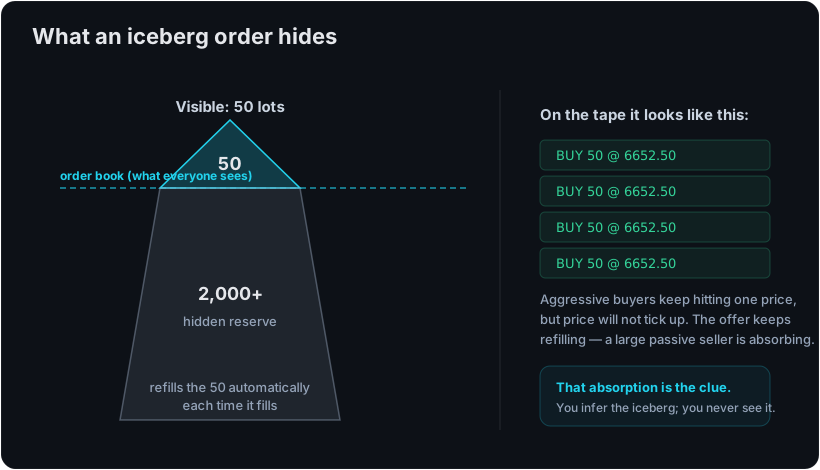
An iceberg order is a large order split so that only a small portion shows in the order book while the rest stays hidden, automatically refilling as the visible part fills. Like an iceberg, most of it sits below the surface. Institutions use them to work significant size at a price without revealing their full hand. You cannot see the hidden reserve directly, but it leaves a footprint on the tape that a careful order flow trader can learn to read. This guide explains how iceberg orders work and how to spot the signs of one.
What Is an Iceberg Order?
When a large participant wants to buy or sell a big position, they face a problem. If they place a single 2,000-lot resting order in the book, everyone sees it. Other traders front-run it, the market moves away, and the fill gets worse. The iceberg order solves this. Instead of showing all 2,000 lots, the order displays only a small tip, say 50 lots. Each time those 50 lots are filled, the exchange automatically replenishes another 50 from the hidden reserve, and it keeps doing so until the full order is complete.
Iceberg orders, also called reserve orders, are a standard and legal order type on major exchanges, including CME futures markets where instruments like the ES and NQ trade. They are a normal part of how large players manage execution. The point of learning to spot them is not that they are sinister; it is that a large hidden order marks a price level someone with size is willing to defend, and that is valuable information.
Why You Cannot Simply See Them
Here is the honest part that a lot of marketing glosses over. The hidden reserve of an iceberg is, by definition, hidden. No indicator can read the portion of the order that the exchange is not publishing. What you can read is the consequence of the order: the way it interacts with the aggressive flow hitting it.
That interaction is called absorption, and it is the real skill here. You are not detecting the iceberg directly. You are recognizing the pattern that a large passive order produces when aggressive traders run into it.
The Signs of Iceberg Activity
Absorption at a price
The clearest sign is absorption. Aggressive buyers keep lifting the offer at one price, print after print, and yet price will not tick higher. The offer keeps refilling faster than it can be cleared. That is what a large passive seller working an iceberg looks like from the outside: the market is throwing aggression at a level and the level is swallowing all of it without giving ground.
The mirror image happens on the buy side. Aggressive sellers keep hitting the bid, the bid keeps refilling, and price holds. A large passive buyer is absorbing the selling.
A cluster of same-size prints
Because an iceberg refills in fixed clips, it often leaves a run of similar-sized trades at the same price on the time and sales. A repeating string of, say, 50-lot prints at one level is a tell that the size is being metered out from a reserve rather than arriving as one natural block.
High trade velocity into a wall
When aggression accelerates into a level and stalls there, the speed of the tape spikes while price stays pinned. That combination, fast trading with no price progress, is a strong absorption signature.
The Tools That Reveal It on NinjaTrader 8
You read iceberg activity with the order flow tools that expose aggression and size, then interpret the absorption yourself.
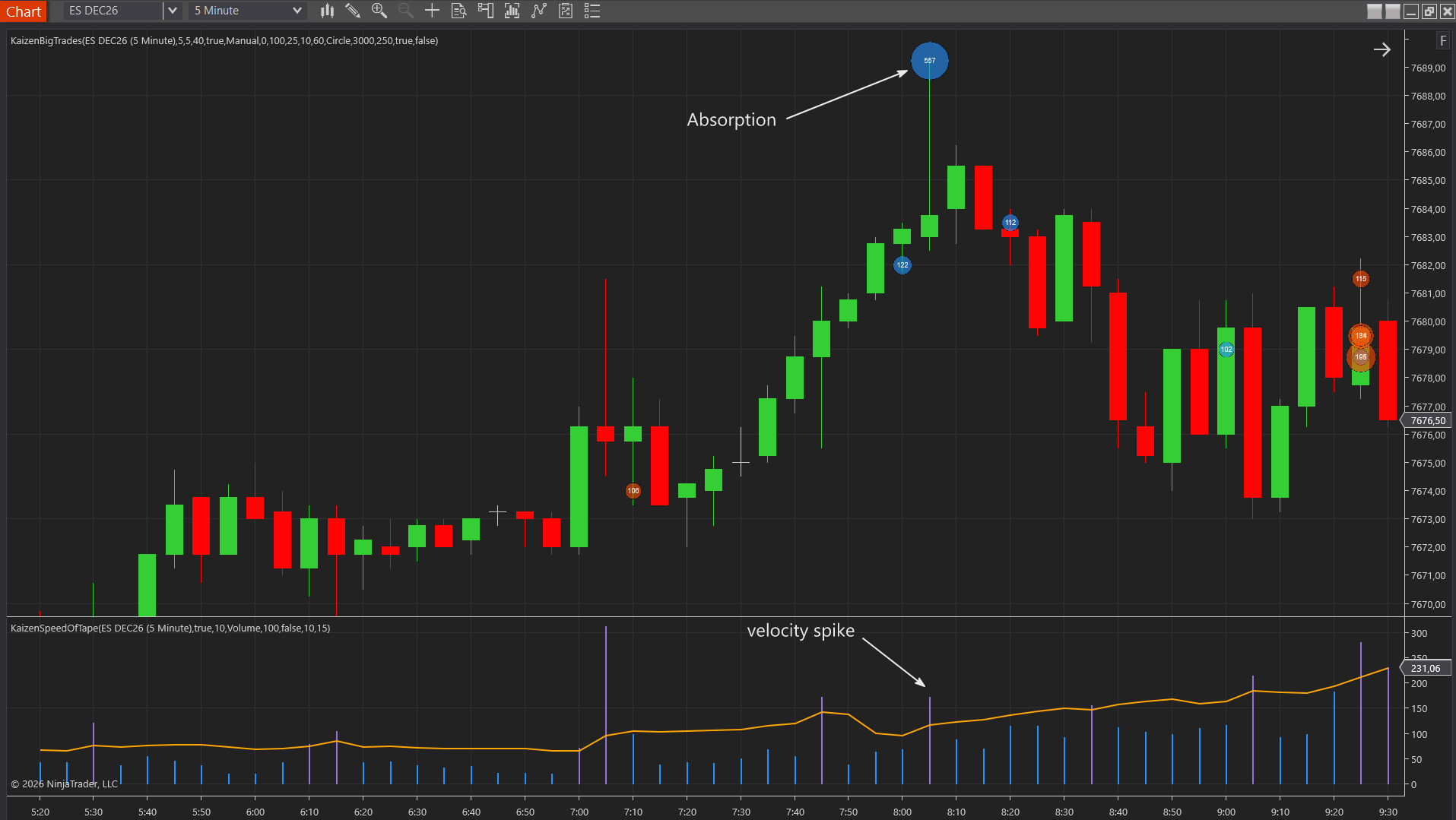
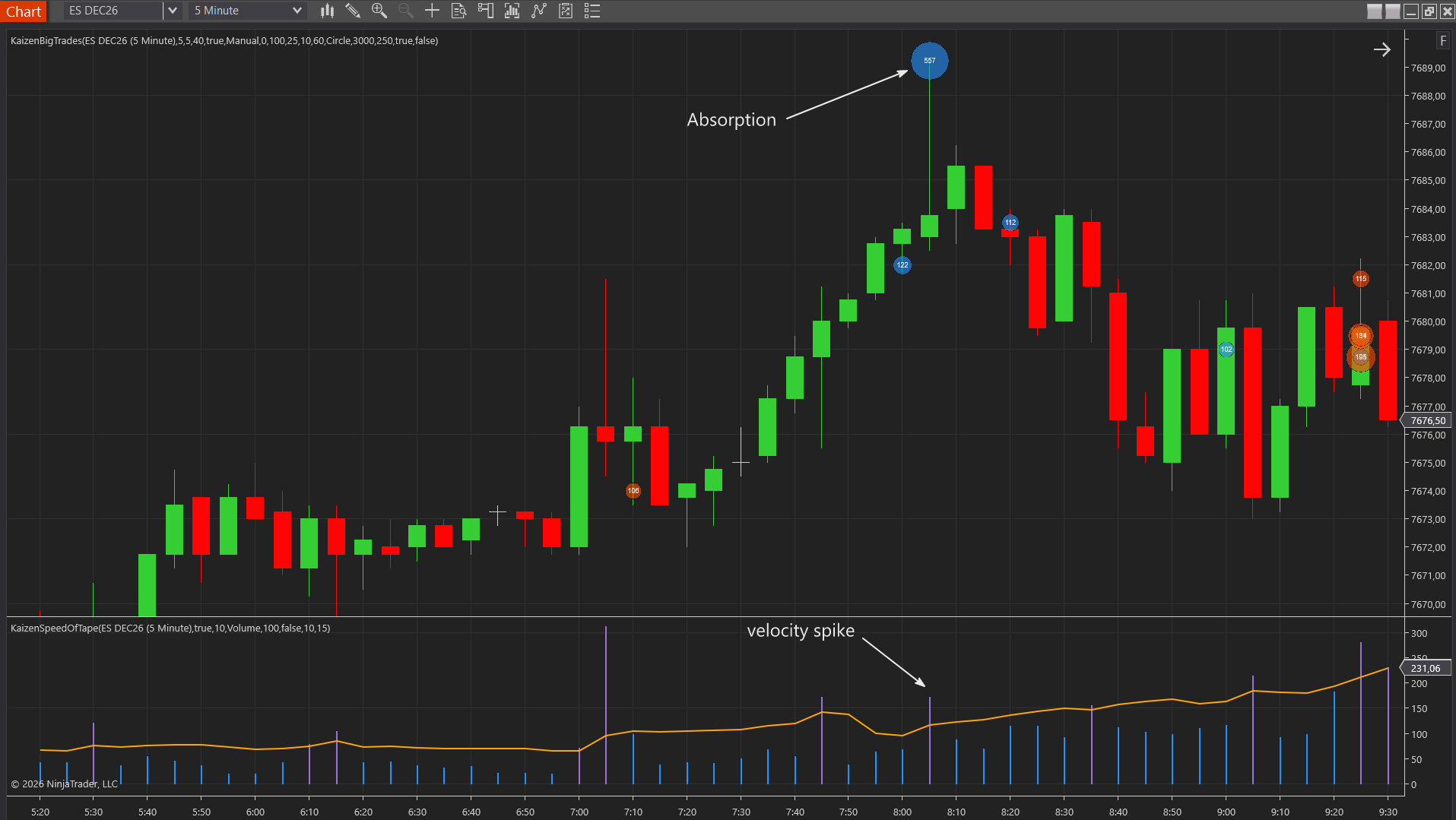
Large-trade detection. Kaizen Big Trades marks large aggressive orders as size-proportional markers on the chart. It shows you the aggressive side of the interaction: the impatient buyers or sellers throwing size at a level. When you see a run of large aggressive prints piling into one price while price refuses to move, you are watching aggression meet a hidden wall.
Speed of the tape. Kaizen Speed of Tape measures how fast volume, ticks or delta are accumulating over a rolling window. A velocity spike that coincides with price stalling at a level is exactly the absorption fingerprint described above. The tape is screaming while price stands still.
A footprint chart adds the final layer of confirmation, because it shows the bid and ask volume at the exact price where the absorption is happening. For the full picture of how these tools work together, see our guide to how to read order flow and our overview of the best NinjaTrader order flow indicators.
Kaizen Big Trades
professionalSpot large aggressive orders with size-proportional markers
$179
Lifetime license
How Traders Use the Read
Spotting absorption does not tell you what to do on its own; it tells you where a battle is being fought and who is winning it. If aggressive sellers keep hitting a bid and a hidden buyer keeps absorbing without price falling, the sellers are spending their ammunition into a wall. When that aggression finally exhausts itself, price frequently snaps back the other way, because the passive side that absorbed everything is now the only side left. Traders watch for that shift, but they also respect that the wall can break: an iceberg can be pulled, and fresh aggression can overwhelm it.
That is why absorption is read as context, not as an automatic entry. It marks a level of interest and a likely battle. Confirmation, your plan, and disciplined risk still do the rest.
Bundle & Save
Order Flow Pro
The complete order flow toolkit
$449
$1163
Save61%
A Realistic Word on Expectations
Reading iceberg activity is inference, not certainty. You are interpreting a footprint left by an order you cannot fully see, and that footprint can mislead. Not every stall is absorption, not every absorption holds, and a level defended all morning can give way in an instant. The tools give you a much clearer view of where size is committed and where aggression is being spent, which is real edge in information. They do not remove risk or guarantee outcomes, and past behavior at a level does not predict future results. Use the read as one input in a disciplined process.
Frequently Asked Questions
What is an iceberg order?
An iceberg order is a large order split so that only a small portion is visible in the order book at any time. As the visible portion fills, the exchange automatically replenishes it from a hidden reserve. It lets a large participant work significant size at a price without revealing the full amount to the rest of the market.
Are iceberg orders legal?
Yes. Iceberg or reserve orders are a standard, exchange-supported order type on major venues, including CME futures markets. They exist to help large participants reduce market impact, and using them is a legitimate part of institutional execution.
How do you detect an iceberg order?
You cannot see the hidden reserve directly, so you infer it from behavior. The classic sign is absorption: aggressive orders keep hitting one price, the visible size at that price keeps refilling, and price refuses to move. Footprint charts, large-trade detection and time and sales all help reveal this pattern.
What is the difference between an iceberg order and a hidden order?
A fully hidden order shows no size in the book at all until it trades. An iceberg order shows a small visible tip that refills from a larger hidden reserve. Both conceal true size, but an iceberg leaves a small, constantly replenishing footprint that observant traders can pick up on.
Why do institutions use iceberg orders?
Showing a very large resting order would move the market against the institution before it could fill. By revealing only a small tip at a time, an iceberg order lets a fund accumulate or distribute a large position with less market impact and less information leakage to other participants.
Related reading
- How to read order flow — absorption, imbalances and exhaustion in a full reading routine
- What is delta in trading? — how heavy delta with no price progress reveals absorption
- What is order flow trading? — the primer on aggressive vs passive participants
- The complete footprint chart guide — bid×ask volume at the exact price of the absorption
- Kaizen Big Trades and Kaizen Speed of Tape
Want to see aggression and absorption clearly on your charts? Kaizen Big Trades and Kaizen Speed of Tape surface the large orders and velocity spikes that reveal hidden size, and both are part of the Order Flow Pro bundle. Compare everything on the pricing page.