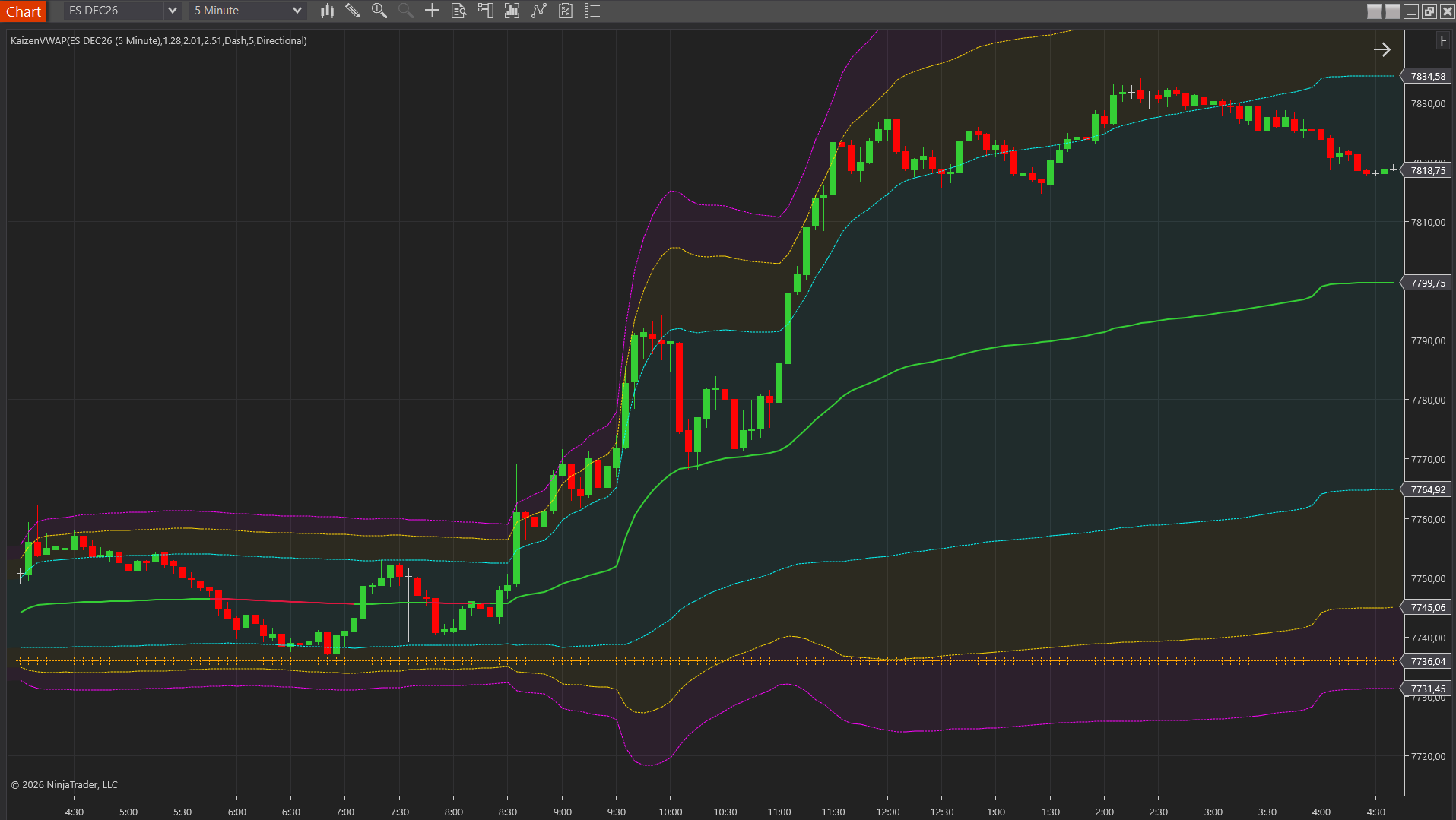
The practical way to use VWAP is as a reference for the state of the day, not as a buy or sell signal. It tells you whether the session is balanced or trending, how stretched price is from the volume-weighted average, and where the market is likely to find responsive participants. This guide walks through how to use VWAP in three common, widely accepted ways, how to read its deviation bands, and, just as importantly, where VWAP falls short. If you are still fuzzy on the basics, start with our explainer on what VWAP is and how it is calculated, then come back here.
First, Read the Day
Before you can use VWAP well, you have to know which kind of day you are in, because VWAP behaves very differently on each. There are broadly two states, and the deviation bands make them easy to see.
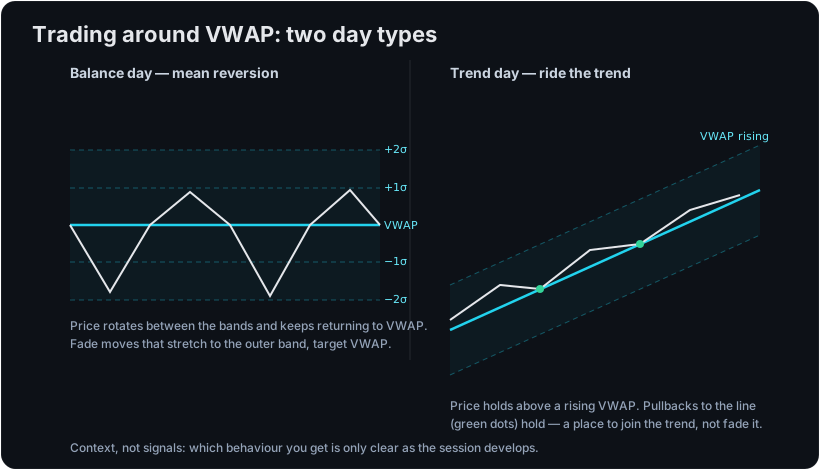
On a balanced day, price rotates around a roughly flat VWAP, pushing out to the bands and coming back. The line acts like a magnet. On a trend day, price establishes itself on one side of a sloping VWAP early and stays there, using the line as a floor or ceiling on pullbacks. The single most useful thing VWAP does is help you tell these apart in real time, because the right behavior on one is the wrong behavior on the other.
The catch, and it is a real one, is that you often do not know which day you have until it is partly developed. A day that looks balanced for the first hour can break into a trend. That uncertainty is exactly why VWAP is context rather than a signal.
Use 1: Mean Reversion on Balanced Days
The most common VWAP approach is mean reversion. On a balanced, rotational day, price that stretches away from VWAP tends to be pulled back toward it. When price extends to an outer deviation band and shows signs of stalling, responsive traders look to fade the move back toward VWAP, treating the line itself as the natural target.
The important word is context. Reaching a band is not a signal by itself. A band tap on a trend day is not a fade, it is a warning that you are trying to stand in front of a freight train. So traders who use this approach lean on confirmation: they want to see the day behaving in a balanced way, and they want some evidence that the aggression pushing price to the band is drying up, which is where order flow tools such as cumulative delta and the footprint earn their place. VWAP defines the where; order flow helps with the when.
A rough, illustrative sequence on a balanced ES day might look like this: price rotates up to the upper band, aggressive buying visibly slows, and price drifts back toward VWAP over the next rotation. The trade idea is framed around VWAP as the target, with risk defined beyond the band. None of that is a recommendation; it is an example of how the tool organizes a decision.
Kaizen VWAP
essentialSession VWAP with directional coloring, 3 SD bands & cloud fills
$99
Lifetime license
Use 2: Trend-Day Pullbacks
On a trend day the logic flips. Instead of fading extension, you respect it. When price holds above a rising VWAP through the morning, each pullback toward the line is a place where trend traders look for the market to resume higher, not a place to short. The line becomes dynamic support in an uptrend and dynamic resistance in a downtrend.
Reading this correctly is what stops mean-reversion traders from getting run over. If you keep trying to fade a move back to VWAP and price keeps holding one band without ever reaching the line, the market is telling you it is a trend day and you should stop fighting it. Many experienced traders treat a clean, decisive break and hold on one side of VWAP as their cue to switch from a fading mindset to a trend-following one for the rest of the session. A simple trend filter such as our free SuperTrend indicator can help confirm that switch.
Again, the pullback to VWAP is a place to look, not an automatic entry. Trends end, and the first pullback that fails to hold VWAP is often the first sign the trend is over. Confirmation and defined risk do the rest.
Use 3: The Bands as a Stretch Gauge
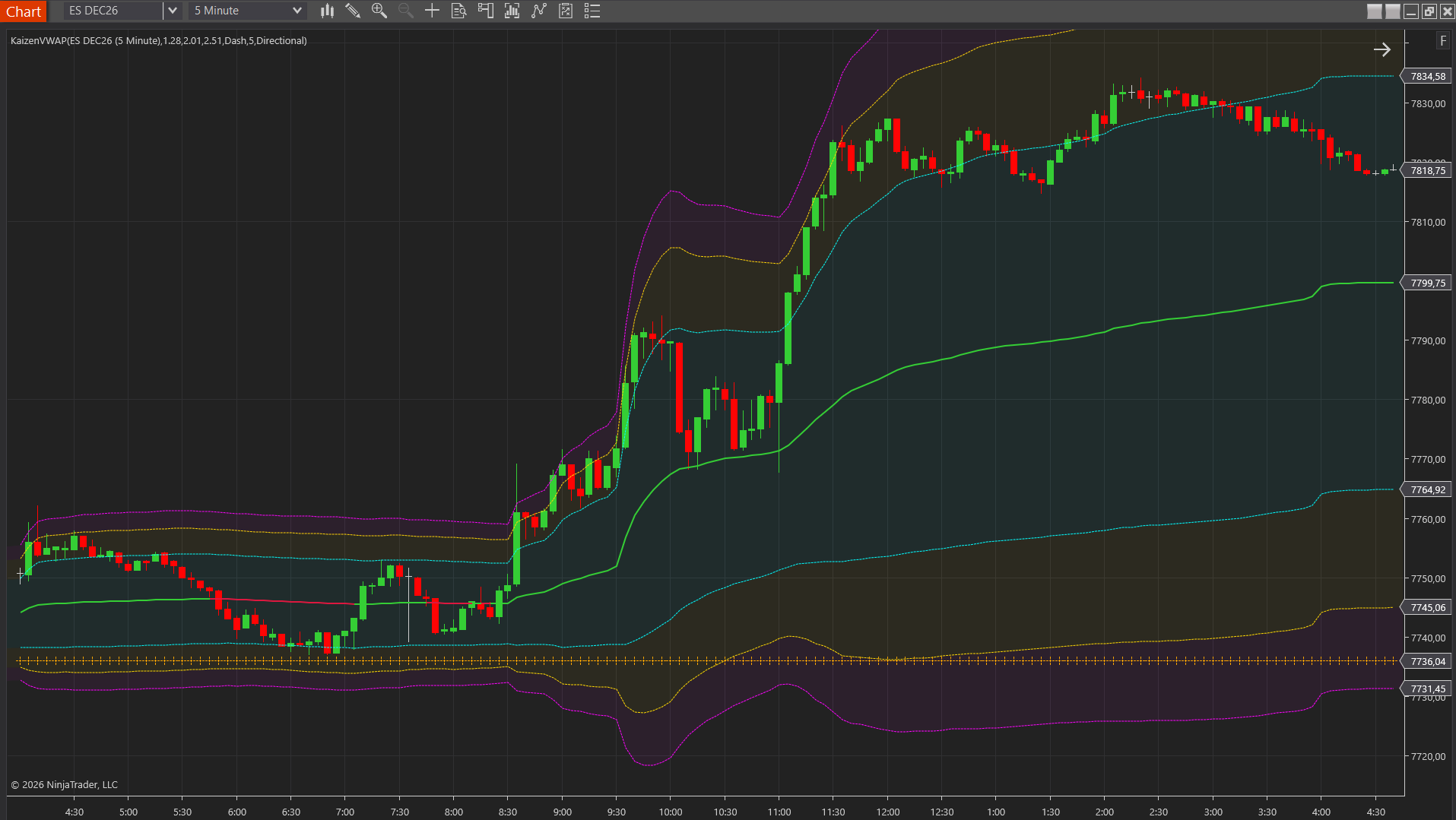
The deviation bands are the third piece. Plotted a set distance above and below VWAP, they give you a quick read on how far price has traveled from the volume-weighted average. Wide, and price is stretched; hugging the line, and the market is coiled near fair value.
Kaizen VWAP gives you three configurable bands with cloud fills, plus directional coloring on the line so you can see at a glance whether VWAP is rising or falling, and the prior session’s VWAP as an extra reference. A common way to use the bands is simply as a discipline check: if you are thinking about a long and price is already jammed against the upper band, you are late to that idea by the standards of the day, whether or not you take the trade.
Treat the bands as a stretch gauge and a context filter. They are not overbought and oversold lines that flip the market on contact.
Combining VWAP With Order Flow and Structure
VWAP is most powerful when it agrees with the rest of your chart. A few pairings traders use:
- VWAP plus volume profile. When the session VWAP lines up with a high-volume node or a prior value area, you have two independent methods pointing at the same level, which strengthens the case for a reaction there. See our volume profile versus TPO guide for the structural side.
- VWAP plus cumulative delta. VWAP tells you where price is stretched; delta tells you whether the aggression driving it is still there. A fade back to VWAP is far more comfortable when delta shows the pushing side losing steam. Our what is order flow guide covers this stack.
- VWAP plus prior-session levels. The prior session VWAP and the overnight range give you fixed references that VWAP can confirm or reject as the day develops. Our free Sessions indicator marks the opening range and initial balance for exactly this kind of intraday framing.
The theme is the same throughout: VWAP organizes the decision, and confluence with other tools raises or lowers your confidence in it.
Bundle & Save
Essentials Pack
Core order flow essentials
$249
$396
Save37%
Where VWAP Falls Short
An honest guide has to say what VWAP cannot do. It is a cumulative average, so it lags by nature; it describes what has already traded, not what will happen next. It is far less reliable in the first minutes of a session, when the running totals are small and the line whips around. It can be misleading on low-volume days and around scheduled news, when a single burst can distort the average. And on a strong trend day, waiting for a reversion to VWAP that never comes is a well-known way to lose money.
None of that makes VWAP less useful; it makes it a tool with a job. Use it for what it is good at, reading the state of the day and framing responsive and trend decisions around a shared benchmark, and lean on other tools where it is weak.
A Realistic Word on Expectations
Everything above is educational, not financial advice, and nothing here is a signal to enter or exit a trade. VWAP improves the quality of your context; it does not remove risk or predict the future. The same setup that works on ten balanced days can fail on the eleventh when the character of the market changes. Any examples are illustrative. Trade your own plan, define your risk before you enter, and remember that past behavior around VWAP does not guarantee future results. If you are new to this, practice on a simulator or NinjaTrader’s Market Replay before risking real capital.
Frequently Asked Questions
How do you use VWAP in a trading strategy?
Most traders use VWAP as a context and reference tool rather than a signal generator. Common approaches are fading extended moves back toward VWAP on balanced days, trading pullbacks to a rising or falling VWAP on trend days, and using the deviation bands to judge how stretched price is. VWAP tells you the state of the day; your plan and confirmation decide the trade.
Is VWAP a good indicator for day trading?
VWAP is one of the most widely used intraday references because it resets each session and is the benchmark large institutions measure their fills against. It is well suited to day trading liquid instruments like index futures. It works best as part of a process alongside market structure and order flow, not as a standalone signal.
What are VWAP bands and how do I use them?
VWAP bands are lines plotted a set distance above and below VWAP, usually based on standard deviation. They show how far price has stretched from the volume-weighted average. On balanced days the outer bands often mark the edges of rotation, while on trend days price can ride an inner band for hours. Treat them as context, not automatic buy or sell levels.
Should I trade with VWAP or against it?
It depends on the type of day. On a balanced, rotational day, price tends to revert to VWAP, so traders lean toward fading stretched moves back to it. On a trend day, price holds on one side of VWAP and pullbacks to the line tend to hold, so traders lean toward joining the trend. Reading which day you are in matters more than the direction itself.
Does VWAP repaint or lag?
VWAP does not repaint; each value is fixed once the session’s volume for that period is known. It is a cumulative average, so like any average it reflects what has already happened rather than predicting what comes next. That is why it is best used as context rather than a leading signal.
Related reading
- What is VWAP? — the definition and the calculation behind the line
- What is order flow trading? — the delta and footprint tools that time entries around VWAP
- Volume profile vs TPO market profile — the structural levels VWAP confirms or rejects
- Best NinjaTrader order flow indicators — how VWAP fits in the full stack
- Kaizen VWAP, plus the free SuperTrend and Sessions indicators
Want VWAP with configurable deviation bands and directional coloring on your NinjaTrader 8 charts? Kaizen VWAP is built for exactly this, and it comes bundled with the other core tools in the Essentials Pack. Compare everything on the pricing page.